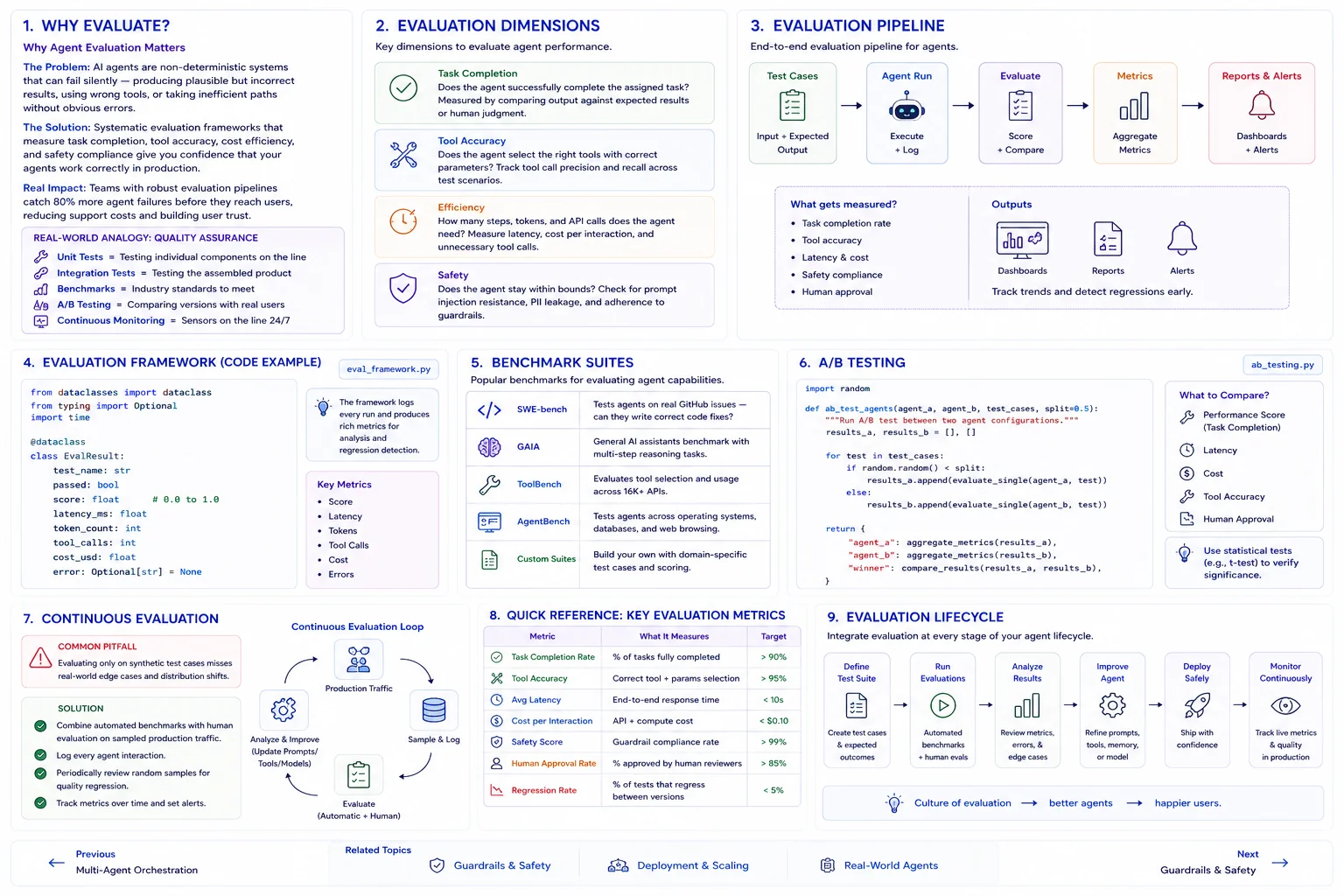
Why Evaluate?
Why Agent Evaluation Matters
The Problem: AI agents are non-deterministic systems that can fail silently -- producing plausible but incorrect results, using wrong tools, or taking inefficient paths without obvious errors.
The Solution: Systematic evaluation frameworks that measure task completion, tool accuracy, cost efficiency, and safety compliance give you confidence that your agents work correctly in production.
Real Impact: Teams with robust evaluation pipelines catch 80% more agent failures before they reach users, reducing support costs and building user trust.
Real-World Analogy
Think of agent evaluation like quality assurance in manufacturing:
- Unit Tests = Testing individual components on the assembly line
- Integration Tests = Testing the assembled product end-to-end
- Benchmarks = Industry standards the product must meet
- A/B Testing = Comparing two product versions with real customers
- Continuous Monitoring = Quality sensors on the production line 24/7
Evaluation Dimensions
Task Completion
Does the agent successfully complete the assigned task? Measured by comparing output against expected results or human judgment.
Tool Accuracy
Does the agent select the right tools with correct parameters? Track tool call precision and recall across test scenarios.
Efficiency
How many steps, tokens, and API calls does the agent need? Measure latency, cost per interaction, and unnecessary tool calls.
Safety
Does the agent stay within bounds? Check for prompt injection resistance, PII leakage, and adherence to guardrails.
Evaluation Metrics
from dataclasses import dataclass
from typing import Optional
import time

@dataclass
class EvalResult:
    test_name: str
    passed: bool
    score: float  # 0.0 to 1.0
    latency_ms: float
    token_count: int
    tool_calls: int
    cost_usd: float
    error: Optional[str] = None

def evaluate_agent(agent, test_cases: list[dict]) -> list[EvalResult]:
    results = []
    for test in test_cases:
        start = time.time()
        try:
            output = agent.run(test["input"])
            latency = (time.time() - start) * 1000

            # Score the output
            score = score_output(output, test["expected"])

            results.append(EvalResult(
                test_name=test["name"],
                passed=score >= test.get("threshold", 0.8),
                score=score,
                latency_ms=latency,
                token_count=output.usage.total_tokens,
                tool_calls=len(output.tool_calls),
                cost_usd=calculate_cost(output.usage),
            ))
        except Exception as e:
            results.append(EvalResult(
                test_name=test["name"], passed=False,
                score=0.0, latency_ms=0, token_count=0,
                tool_calls=0, cost_usd=0, error=str(e),
            ))
    return results
Benchmark Suites
Popular Agent Benchmarks
- SWE-bench: Tests agents on real GitHub issues -- can they write correct code fixes?
- GAIA: General AI assistants benchmark with multi-step reasoning tasks
- ToolBench: Evaluates tool selection and usage across 16K+ APIs
- AgentBench: Tests agents across operating systems, databases, and web browsing
- Custom suites: Build your own with domain-specific test cases and scoring
A/B Testing
import random

def ab_test_agents(agent_a, agent_b, test_cases, split=0.5):
    """Run A/B test between two agent configurations."""
    results_a, results_b = [], []

    for test in test_cases:
        if random.random() < split:
            results_a.append(evaluate_single(agent_a, test))
        else:
            results_b.append(evaluate_single(agent_b, test))

    return {
        "agent_a": aggregate_metrics(results_a),
        "agent_b": aggregate_metrics(results_b),
        "winner": compare_results(results_a, results_b),
    }
Continuous Evaluation
Common Pitfall
Problem: Evaluating only on synthetic test cases misses real-world edge cases and distribution shifts.
Solution: Combine automated benchmarks with human evaluation on sampled production traffic. Log every agent interaction and periodically review random samples for quality regression.
Quick Reference
| Metric | What It Measures | Target |
|---|---|---|
| Task Completion Rate | % of tasks fully completed | > 90% |
| Tool Accuracy | Correct tool + params selection | > 95% |
| Avg Latency | End-to-end response time | < 10s |
| Cost per Interaction | API + compute cost | < $0.10 |
| Safety Score | Guardrail compliance rate | > 99% |
| Human Approval Rate | % approved by human reviewers | > 85% |
| Regression Rate | % of tests that regress between versions | < 5% |