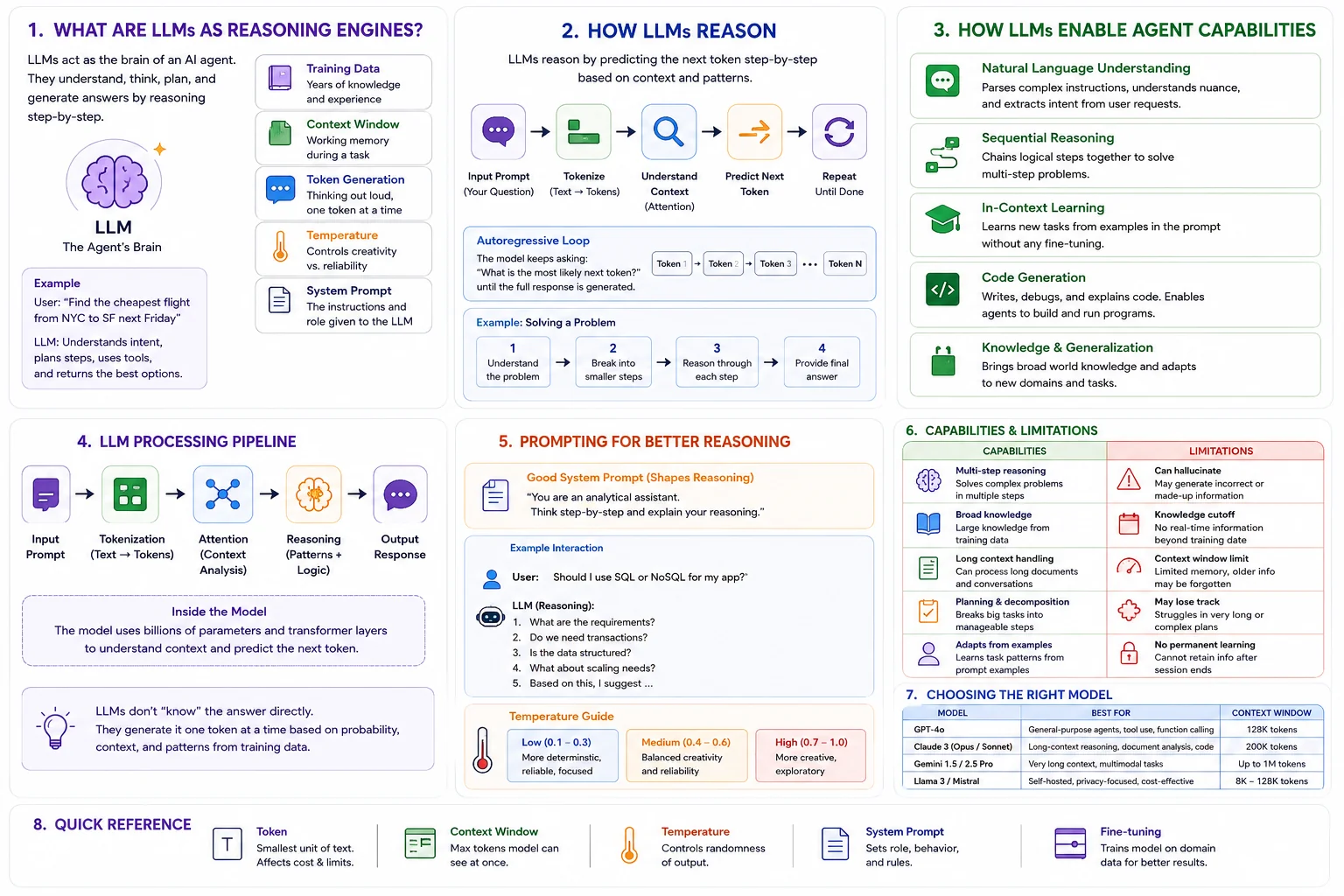
LLMs as the Agent's Brain
Why This Matters
The Problem: Building intelligent systems traditionally required hand-coding every decision rule, making them brittle and limited in scope.
The Solution: Large Language Models provide general-purpose reasoning capabilities that can understand context, generate plans, and adapt to new situations -- serving as the cognitive engine for AI agents.
Real Impact: LLMs like GPT-4, Claude, and Gemini have enabled agents that can reason about code, research papers, business processes, and more -- all with a single model.
Real-World Analogy
Think of an LLM as a brilliant generalist consultant:
- Training Data = Years of education and experience across many fields
- Context Window = Their working memory during a meeting
- Token Generation = Thinking out loud, one word at a time
- Temperature = How creative vs. conservative their suggestions are
- System Prompt = The briefing document they read before starting work
How LLMs Enable Agent Reasoning
Natural Language Understanding
LLMs parse complex instructions, understand nuance, and extract intent from ambiguous user requests.
Sequential Reasoning
Through autoregressive generation, LLMs can chain logical steps together to solve multi-step problems.
In-Context Learning
LLMs can learn new tasks from examples provided in the prompt, without any fine-tuning or retraining.
Code Generation
Models can write, debug, and reason about code -- enabling agents to create and execute programs dynamically.
How LLMs Reason
Prompting for Reasoning
from openai import OpenAI

client = OpenAI()

# The system prompt shapes HOW the LLM reasons
response = client.chat.completions.create(
    model="gpt-4o",
    messages=[
        {"role": "system", "content": "You are an analytical agent. Think step-by-step."},
        {"role": "user", "content": "Should I use SQL or NoSQL for my app?"}
    ],
    temperature=0.2,  # Lower = more deterministic reasoning
    max_tokens=1000
)
Capabilities & Limitations
| Capability | Strength | Limitation |
|---|---|---|
| Reasoning | Multi-step logical chains | Can hallucinate intermediate steps |
| Knowledge | Broad world knowledge from training | Knowledge cutoff date, no real-time info |
| Context | Can process long documents | Context window has finite limit |
| Planning | Can decompose complex tasks | May lose track in very long plans |
| Adaptation | Learns from in-context examples | Cannot permanently learn new information |
Choosing a Model
| Model | Best For | Context Window |
|---|---|---|
| GPT-4o | General-purpose agents, function calling | 128K tokens |
| Claude Opus/Sonnet | Long-context reasoning, code agents | 200K tokens |
| Gemini 2.5 Pro | Multimodal agents, large context | 1M tokens |
| Llama / Mistral | Self-hosted, privacy-sensitive agents | 8K-128K tokens |
Quick Reference
| Concept | Description | Agent Relevance |
|---|---|---|
| Token | Smallest unit of text processed | Determines cost and context budget |
| Context Window | Max tokens the model can process | Limits agent memory and tool output |
| Temperature | Controls output randomness | Lower for reliable, higher for creative |
| System Prompt | Initial behavior instructions | Defines agent personality |
| Fine-tuning | Domain-specific training | Improves task-specific performance |