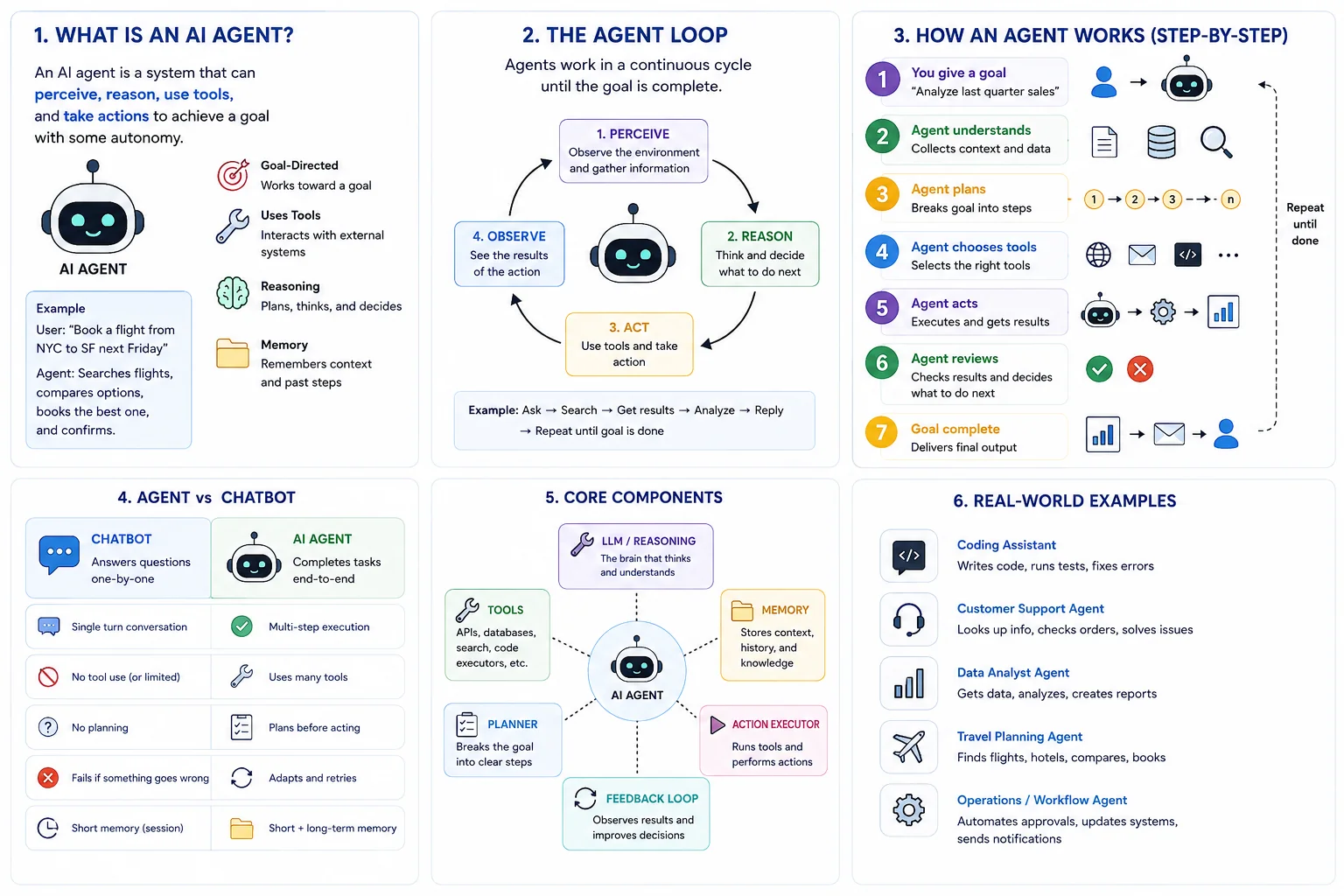
What is an AI Agent?
Why AI Agents Matter
The Problem: Traditional chatbots can only respond to messages -- they cannot take action, use tools, or work autonomously toward a goal.
The Solution: AI agents combine LLM reasoning with the ability to perceive their environment, make decisions, and take actions -- creating systems that can accomplish complex tasks independently.
Real Impact: AI agents are powering coding assistants, research tools, customer support systems, and autonomous workflows across every industry.
Real-World Analogy
Think of an AI agent as a skilled employee rather than an answering machine:
- Chatbot = A phone answering machine that plays pre-recorded responses
- AI Agent = An employee who listens, thinks, uses tools, and completes tasks
- LLM = The employee's brain -- capable of reasoning and planning
- Tools = The employee's toolkit -- APIs, databases, search engines
- Memory = The employee's notebook -- retaining context across interactions
Core Characteristics of AI Agents
Autonomy
Agents operate independently, making decisions without constant human input. They determine the next step based on context.
Tool Use
Agents can call external tools -- APIs, databases, code interpreters -- to interact with the real world beyond text generation.
Reasoning
Powered by LLMs, agents can break down complex problems, plan multi-step solutions, and adapt when things go wrong.
Goal-Directed
Unlike chatbots that respond turn-by-turn, agents work toward completing a specific objective through multiple steps.
Agent vs Chatbot
| Feature | Traditional Chatbot | AI Agent |
|---|---|---|
| Interaction | Single turn Q&A | Multi-step task completion |
| Tool Access | None or hardcoded | Dynamic tool selection and use |
| Planning | No planning ability | Breaks down goals into sub-tasks |
| Memory | Conversation history only | Short-term + long-term memory |
| Error Handling | Returns error message | Retries, adapts, finds alternatives |
The Agent Loop
Core Components of an Agent
import openai

class SimpleAgent:
    def __init__(self, system_prompt, tools):
        self.system_prompt = system_prompt
        self.tools = tools
        self.messages = [
            {"role": "system", "content": system_prompt}
        ]

    def run(self, user_input):
        # 1. PERCEIVE: Add user input to context
        self.messages.append({
            "role": "user",
            "content": user_input
        })

        while True:
            # 2. REASON: Call LLM to decide next action
            response = openai.chat.completions.create(
                model="gpt-4o",
                messages=self.messages,
                tools=self.tools
            )

            message = response.choices[0].message

            # 3. ACT: Execute tool or return response
            if message.tool_calls:
                for tool_call in message.tool_calls:
                    result = self.execute_tool(tool_call)
                    self.messages.append(result)
            else:
                return message.content
Types of Agents
Reactive Agents
Respond directly to inputs without internal state. Simple stimulus-response behavior -- fast but limited in complex reasoning.
Deliberative Agents
Maintain an internal model of the world and use planning to decide actions. Better at complex tasks but slower to respond.
Hybrid Agents
Combine reactive and deliberative approaches. Use fast reactive responses for simple tasks and deliberation for complex ones.
Multi-Agent Systems
Multiple specialized agents working together, each handling a different aspect of a complex problem.
Quick Reference
| Concept | Description | Example |
|---|---|---|
| Agent | Autonomous system that perceives, reasons, and acts | Coding assistant that writes, tests, and debugs code |
| Tool | External capability the agent can invoke | Web search, database query, code execution |
| Agent Loop | Continuous cycle of perceive-reason-act | Read error -> analyze cause -> apply fix -> verify |
| System Prompt | Instructions defining agent behavior and capabilities | "You are a research assistant with access to..." |
| Memory | Retained context across interactions | Conversation history, user preferences, past results |