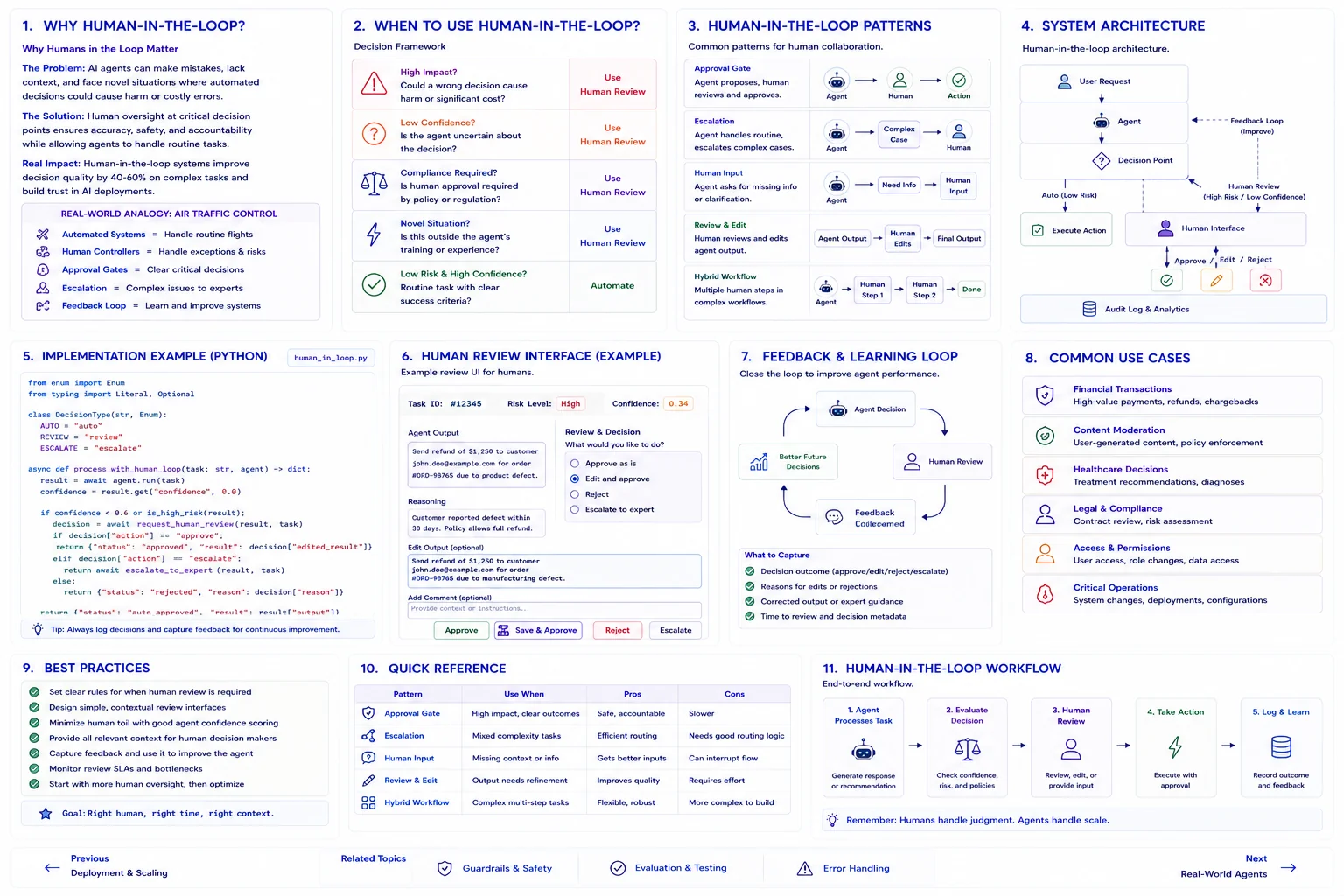
Why Human-in-the-Loop?
Why Human-in-the-Loop Matters
The Problem: Fully autonomous agents make mistakes on edge cases, can take irreversible actions, and lack the judgment needed for high-stakes decisions -- eroding user trust.
The Solution: Human-in-the-loop patterns let agents handle routine work autonomously while routing uncertain, risky, or high-value decisions to humans for review and approval.
Real Impact: Teams implementing HITL patterns see 40% higher user satisfaction and 90% fewer critical errors compared to fully autonomous deployments.
Real-World Analogy
Think of HITL like a self-driving car with a human driver:
- Autonomous Mode = Highway driving where the AI handles everything
- Approval Gate = Asking the driver before changing lanes in heavy traffic
- Escalation = Handing control back to the driver in construction zones
- Confidence Threshold = The certainty level needed to proceed without asking
- Feedback Loop = The AI learning from every driver intervention
HITL Design Patterns
Approval Gates
Agent pauses before critical actions (sending emails, modifying data) and waits for explicit human approval to proceed.
Confidence-Based Routing
Agent handles high-confidence tasks autonomously but escalates to humans when confidence drops below a threshold.
Human Escalation
Agent recognizes when it cannot solve a problem and transfers the conversation to a human specialist with full context.
Feedback Learning
Human corrections and approvals are captured and used to improve agent behavior over time through fine-tuning or prompt updates.
Approval Workflows
from langgraph.graph import StateGraph, END
from langgraph.checkpoint.sqlite import SqliteSaver

# Build graph with human interrupt
graph = StateGraph(AgentState)
graph.add_node("agent", agent_node)
graph.add_node("tools", tool_node)

graph.set_entry_point("agent")
graph.add_conditional_edges("agent", should_continue, {
    "tools": "tools",
    "end": END,
})
graph.add_edge("tools", "agent")

# Compile with interrupt BEFORE tool execution
memory = SqliteSaver.from_conn_string(":memory:")
app = graph.compile(
    checkpointer=memory,
    interrupt_before=["tools"],  # Pause here for human review
)

# Run until interrupt
config = {"configurable": {"thread_id": "user-1"}}
result = app.invoke({"messages": ["Send email to boss"]}, config)

# Human reviews the pending tool call...
print("Agent wants to:", result["messages"][-1].tool_calls)

# Human approves - resume execution
result = app.invoke(None, config)  # Continue from checkpoint
Escalation Patterns
def confidence_router(state: AgentState) -> str:
    """Route based on agent confidence level."""
    last_msg = state["messages"][-1]

    # Extract confidence from agent's reasoning
    confidence = extract_confidence(last_msg.content)

    if confidence >= 0.9:
        return "auto_execute"    # High confidence: proceed
    elif confidence >= 0.6:
        return "human_approve"   # Medium: ask for approval
    else:
        return "human_takeover"  # Low: hand off entirely

def escalate_to_human(state: AgentState) -> AgentState:
    """Transfer to human with full context."""
    context = {
        "conversation": state["messages"],
        "agent_reasoning": state.get("reasoning", ""),
        "attempted_actions": state.get("actions", []),
        "failure_reason": state.get("error", "Low confidence"),
    }
    notify_human_agent(context)
    return {"status": "escalated"}
Feedback Integration
Feedback Loop Design
- Thumbs Up/Down: Simple binary feedback on agent responses for quality tracking
- Correction Capture: When humans modify agent outputs, store the correction as training data
- Approval Rates: Track what percentage of agent actions are approved vs rejected
- Prompt Refinement: Use rejection patterns to improve system prompts and tool descriptions
Collaborative Agents
Common Pitfall
Problem: Too many approval gates create "alert fatigue" where humans rubber-stamp everything without reviewing.
Solution: Only require approval for high-risk or irreversible actions. Use confidence-based routing so that most interactions are autonomous. Track approval response times and adjust thresholds if humans are approving too quickly.
Quick Reference
| Pattern | When to Use | Implementation |
|---|---|---|
| Approval Gate | Before irreversible actions | LangGraph interrupt_before |
| Confidence Routing | Variable-certainty tasks | Threshold-based conditional edge |
| Full Escalation | Agent cannot solve task | Human takeover with context |
| Feedback Capture | All interactions | Store corrections + ratings |
| Collaborative Edit | Content generation | Agent drafts, human refines |
| Audit Trail | Regulated industries | Log all decisions + approvals |
| Gradual Autonomy | New deployments | Start strict, relax over time |